Who Wins War?

Two countries go to war. Who is going to win?
It seems like the stronger country should win, but there are plenty of cases where superpower states had to retreat. The United States in Vietnam or Afghanistan comes to mind. Afghanistan also resisted invasions by the Soviet Union and the British Empire, earning it the title ‘the graveyard of empires’.
The Afghanistan example raises two key points. First, along with capability, a state’s success in war also depends on its resolve. A state’s capability represents its military strength, or its ability to impose costs on its adversary. A state’s resolve is based on its motivations, or how much cost it is willing to tolerate.1 Thus, Afghanistan’s success may be partly due to its resolve.
The second point is that war outcomes are judged based on each side’s goals and gains.2 Throughout the Afghanistan War, Afghanistan never occupied any U.S. territory, but that wasn’t Afghanistan’s goal. So when we ask ‘Who wins wars?’, we are really asking is ‘Who achieves their goals or makes gains through war?’
Research shows that states are more likely to achieve their goals when they are fighting closer to home, choose appropriate force deployment, and have aims that don’t require their adversary’s cooperation. Democracies win more often, as does the initiating state. Also, fighting a state that violates human rights may increase success by strengthening resolve.
A key puzzle in foreign affairs is: if states are making rational decisions based on cost-benefit analysis, then why do states fight costly wars instead of making a bargain that keeps the peace and leaves both sides better off? With all of these factors that make success more likely, we should ask why they would have that effect instead of simply being factored in to the pre-war bargain. How do these factors interact with these four major explanations for why a pre-war agreement can’t be reached, described in greater detail in my post How War’s End: - Uncertainty - their cost-benefit analysis is incorrect - Inability to Credibly Commit - a state cannot believe that its adversary will keep to the deal - Uneven Domestic Distribution - a leader might benefit even as their state suffers - Human Psychology - states might not be rational
Distance
The U.S. performs worse in international militarized disputes that are further away. Over time, the U.S. has engaged in disputes further from home, moving from the Western Hemisphere to Europe, Asia, and the Middle East after World War II. The United State’s performance decreases over time, but analysis shows that the increased distance better explains the worsening outcomes.3
Fighting further away from home brings many challenges. Projecting force further away is costly, decreasing the capabilities that can be actually applied. The United States may have less information about distant foes, creating uncertainty about the adversary’s capabilities and resolve. Lack of cultural understanding can hinder the United States’ ability to plan and operate effectively, further constraining its capabilities. Additionally, when the adversary is further away, it may seem less salient to national security and thus have less public support, diminishing U.S. resolve.
If the United States government is aware of these challenges, it should factor them into their international negotiations and try to reach agreements that avoid distant wars, and if it isn’t aware it should learn over time. Scholars have suggested that the decreased information about the foe and of domestic public support make it more difficult for decision-makers to predict their odds of victory. That uncertainty may leave more room for the generally hawkish ideology of U.S. foreign policy to err on the side of over-confidence.4
Force Employment
Capability depends not just on what is deployed but also how they are deployed. The most effective method depends on the type of conflict. In theaters like World War I, armies that used a combination of cover, concealment, dispersion, suppressive fire, combined arms, and depth and reserve, referred to as the modern system, had a major advantage on the battlefield.5 In asymmetric conflicts - conflicts between a strong power and a weak power - strong powers succeeded in 76% of cases where they matched the weak power’s strategy and in 37% of cases where they did not.6
Why don’t forces always choose the optimal strategy? First, complex force employment methods like the modern system may be difficult to master.7 Second, forces are developed to fight in a certain way, perhaps based on national identity, military tradition, or to counter a primary adversary. Once equipment is acquired and soldiers are trained, they may be ill-suited to employ the ideal strategy or tactics for other conflicts. For example, the mechanization of modern armies has decreased their effectiveness fighting insurgencies.8
So why can’t states account for force employment in their pre-war estimates and reach a deal? Uncertainty seems a likely explanation. That same national identity that led a state to adopt suboptimal force employment may also cause them to overestimate its effectiveness. In the case of asymmetric wars, it may be unclear what strategy the adversary is going to use. In some cases, the strategy may shift. In the Vietnam War, the weaker power’s strategy shifted from direct engagement to indirect guerrilla warfare after the U.S. defeated the North Vietnamese Army.9
Aims
Military interventions by major powers are more successful when their objective is less reliant on compliance from their adversary.10 Some objectives lend themselves to brute force, such as acquiring territory, seizing resources, or overthrowing a regime. The adversary can resist these objectives and impose costs on the major power, but ultimately the major power can succeed with sufficient force. Other objectives such as policy change or peacemaking require some level of cooperation by the adversary. While the major power can still use force to impose costs on the adversary, it is ultimately up to the adversary to agree to change their policy or make peace. The full spectrum of objectives is shown in Figure 2.
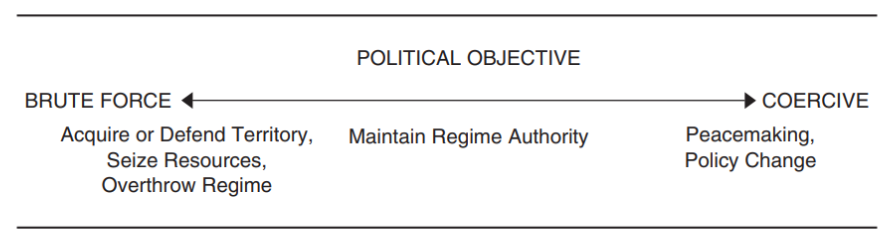
Analysis across 120 interventions shows that military capabilities do not explain success, but the aims do. When a major power has a brute force objective, its predicted probability of success is over 75%. When they have a fully coercive goal, their probability of success is only 20%. In addition, the major power is 20% more likely to succeed when they are acting in support of a local government, but 62% less likely to succeed if the adversary is supported by troops from an ally.
What explains the different outcomes between brute force and coercive aims? The researchers posit that compared to brute force goals, success on coercive goals depend more on the target’s resolve, which is more difficult to assess. This means the major power will likely be less accurate in their pre-war estimates of the costs of conflict, leading them to launch interventions that they cannot sustain.11
Democracy
Democracies are theorized to be more successful in war because (1) democratic leaders should be more concerned about being voted out if they lose a war and (2) freedom of speech and press in democracies makes for a robust marketplace of ideas which helps democratic leaders make better estimates of the likelihood of success and avoid risky wars.12 To the first point, see my review on leader consequences for war.
The actual evidence that democracies are more successful in war varies depending on how you set up the analysis. If you look at wars between 1816-1987 and ignore wars that ended in draws, then democracies win 93% of the wars they start while non-democracies win 60%, which is a major difference.13
However, if you do account for wars that ended in draws, democracies win 65% of the wars they start versus 51% for non-democracies; this smaller difference is not statistically significant, meaning that the difference is small enough that we cannot be confident that it is not just due to chance. But if you include initiators and defenders, count all wars, and include draws, democracies win 59% vs. non-democracies 40%, which is statistically significant.
Initiation
While both states may fail to reach a pre-war agreement, the state that actually initiates the war is more likely to win (53%) than defenders (34%).14 A simple explanation is that the initiator must believe they will win, and we can assume that this belief must be grounded in reality.15 That seems like a pretty big assumption though, and it does not answer the question of why the defender wasn’t able to reach a pre-war deal. We can speculate that the initiator might gain some first strike advantage, or the defender may have uncertainty whether the initiator is bluffing or can even credibly commit to a deal, I am unaware of any research that tests these or other explanations. Still, some have argued though that war initiation is difficult to code or makes little sense given the possibility for pre-war bargains.16
Human Rights
Can human rights effect war outcomes? If we assume that democracies have better human rights records than the above discussion suggests a correlation between human rights and war victory, but it is unclear what that mechanism would be.
There is some evidence that states with worse human rights may strengthen the resolve of their opponent. Survey experiments in the United States and United Kingdom found that public support for a hypothetical war increased when the target reportedly violated human rights; respondents were more likely to see the target as a threat and had fewer moral qualms about going to war.17
Good Answers, Wrong Question
We reviewed six factors that can affect who wins a war: distance, force employment, aims, democracy, initiation, and human rights. These are good answers supported by quality research. However, I would argue that instead of asking ‘Who Wins Wars?’, what we really want to know is ‘Who Succeeds?’. The point being that the start of a war already represents a bargaining failure. Once the fighting has begun, it is obviously preferable to win, but even better than that would have been to reach a deal that accomplished your goals without a war.
Footnotes
Maoz, Zeev. 1983. “Resolve, Capabilities, and the Outcomes of Interstate Disputes, 1816-1976.” Journal of Conflict Resolution 27 (2): 195–229. https://doi.org/10.1177/0022002783027002001. Sullivan, Patricia L. 2007. “War Aims and War Outcomes: Why Powerful States Lose Limited Wars.” Journal of Conflict Resolution 51 (3): 496–524. https://doi.org/10.1177/0022002707300187.↩︎
The Militarized Interstate Dispute dataset defines victory as a favorable alteration in the status quo.(Dispute Coding Manual, found in the MID 5 Data and Supporting Materials) The International Crisis Behavior dataset determines victory based on the achievement of goals (Brecher, Michael, Jonathan Wilkenfeld, Kyle Beardsley, Patrick James and David Quinn (2025). International Crisis Behavior Data Codebook, Version 16. http://sites.duke.edu/icbdata/data-collections/).↩︎
Hulme, M. Patrick, and Erik Gartzke. 2021. “The Tyranny of Distance: Assessing and Explaining the Apparent Decline in U.S. Military Performance.” International Studies Quarterly 65 (2): 542–50. https://doi.org/10.1093/isq/sqaa067.↩︎
Hulme and Gartzke 2021↩︎
Biddle, Stephen. 2004. Military Power: Explaining Victory and Defeat in Modern Battle. Princeton University Press.↩︎
Arreguin-Toft, Ivan. 2001. “How the Weak Win Wars: A Theory of Asymmetric Conflict.” International Security 26 (1): 93–128.↩︎
Arreguin-Toft 2001, Biddle 2004.↩︎
Lyall, Jason, and Isaiah Wilson III. 2009. “Rage Against the Machines: Explaining Outcomes in Counterinsurgency Wars.” International Organization 63 (1): 67–106. https://doi.org/10.1017/S0020818309090031.↩︎
Arreguin-Toft 2001↩︎
Sullivan, Patricia L. 2007. “War Aims and War Outcomes: Why Powerful States Lose Limited Wars.” Journal of Conflict Resolution 51 (3): 496–524. https://doi.org/10.1177/0022002707300187.↩︎
Sullivan 2007↩︎
Reiter, Dan, and Allan C. Stam. 2002. Democracies at War. Princeton University Press.↩︎
Rieter and Stam 2002. Downes, Alexander B. 2009. “How Smart and Tough Are Democracies? Reassessing Theories of Democratic Victory in War.” International Security 33 (4): 9–51. Reiter, Dan, Allan C. Stam, and Alexander B. Downes. 2009. “Another Skirmish in the Battle over Democracies and War.” International Security 34 (2): 194–204.↩︎
Reiter et al 2009↩︎
Reiter, Dan, and Allan C. Stam III. 1998. “Democracy, War Initiation, and Victory.” American Political Science Review 92 (2): 377–89.↩︎
Croco, Sarah E., and Jessica LP Weeks. 2016. “War Outcomes and Leader Tenure.” World Politics 68 (4): 577–607.↩︎
Tomz, Michael R., and Jessica L. P. Weeks. 2020. “Human Rights and Public Support for War.” The Journal of Politics 82 (1): 182–94. https://doi.org/10.1086/705741.↩︎